|
|
|
|
Limit is a function. and Reading Limit Notation A function is a really dependable rule. The argument is the thing on which (or with which) the function is operated or performed. In the limit expression below, most would say the argument is the function (x+5)/(x+2). The limiting constant, 2, is the "unstated argument." See an animation on how to read limit notation. |
|
Use division to transform the expression for easy graphing.
The function f(x) = (x+5)/(x+2) can be easily seen to have
More than that may not be easy to see, but, a little bit of long division makes the rational expression look more like a function that is easy to graph. Click here to see an animation on the division. |
| Think APPROACH to take a limit.
BY DEFINITION, if the limit is not labeled "from above" or "from below," one must approach the limit from above and from below and these values must be equal for a limit to exist.  For continuous (and some other) functions, taking a limit requires one simply to approach, get closer and closer, to evaluate the limit.
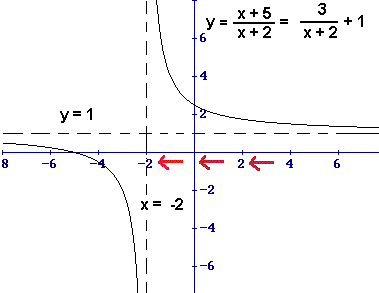
Look at the graph of the function then take a limit graphically. Click on the expression to view the answer.
|
|
Approach the limit from above.
Look at the graph. Approach the limit from above and check the answer by clicking on the expression.
|
|
Approach the limit from below.
Look at the graph. Approach the limit from below and check the answer by clicking on the expression.
|
|
Take a limit.
Look at the graph. State the limit and check the answer by clicking on the expression.
|
|
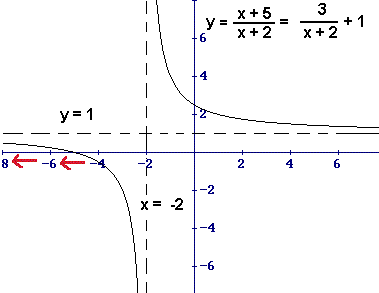
Take a limit at infinity.
Look at the graph. Take a limit at negative infinity. Check the answer.
|

|
|
Here simpler vocabulary is used, believing Isaac Newton and Gottfried Wilhelm Leibniz would not mind. This is a list of vocabulary for one who has forgotten how or never learned how to "speak math."
Before reading further, look at and examine the epsilon-delta sheet in the Sketch Pad. It is the same sketchpad that is listed as "limit" often on this page. The goal is to recognize the symbols you know and to become ready to learn the meaning of new symbols.
See if the definition below on the left return and the image below on the right make sense. Click on the images to enlarge them. Play on the sketchpad to clarify the definition.
|
![[MC,i. Home]](http://www.mathnstuff.com/math/spoken/here/1gif/mcihome.gif)

![[Words]](http://www.mathnstuff.com/math/spoken/here/1gif/words.gif)


www.mathnstuff.com/math/spoken/here/2class/420/limit.htm |